
Kenfack Ibrahim runs a food and consumer goods distribution company. His customers: shops, mini-markets, restaurants, small resellers, corner stores. His business runs well — he sells regularly. But a significant share of his customers don't pay cash: a deposit on order, partial payment on delivery, the balance a few days later, sometimes in several installments.
« Boss, I'll give you the rest on Friday. »
Kenfack Ibrahim knows that line well. The problem isn't that one customer pays a few days later — it starts when ten, twenty, or thirty customers say the same thing. At that point, it's no longer enough to know how much the company has sold. He needs to know who still owes money, how much each customer owes, what they've already paid, which invoice the payment matches, and how long the balance has been outstanding. This is exactly what Kenfack Ibrahim decides to track with zBilling.net.
The sale is invoiced
Kenfack Ibrahim creates the invoice for Boutique Grâce : 450,000 F of goods, with 200,000 F paid on delivery — 250,000 F remains.
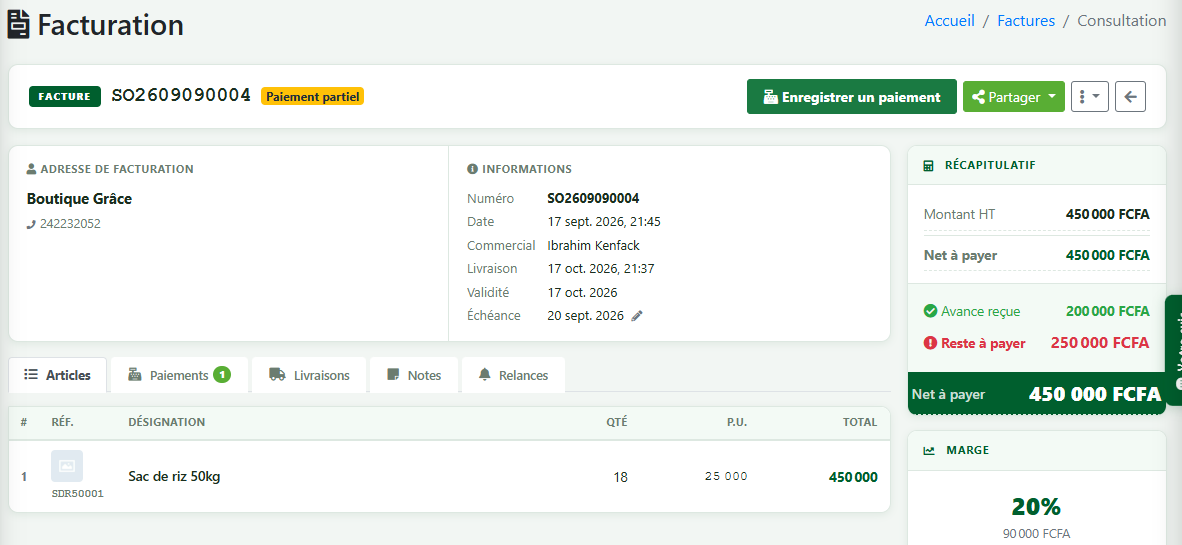
Key takeaway — a 450,000 F sale doesn't mean 450,000 F is already in the cash flow. From this moment on, the balance is no longer something to remember mentally: the debt is tied to the right customer, the right invoice, and the payment already received.
Friday arrives, but the customer doesn't pay
Friday passes. No new payment. In a loosely organized business, someone has to remember: "Boutique Grâce still owes us 250,000 F." With zBilling.net, that information is already recorded — Kenfack Ibrahim pulls up the invoice and sees that 450,000 F was invoiced, 200,000 F collected, 250,000 F remains outstanding, due date shown in black and white. Tracking no longer depends on a salesperson's memory or a WhatsApp message.
Invoiced isn't the same as collected. For this sale: 450,000 F invoiced, 200,000 F collected, 250,000 F still owed. A company can show strong revenue while still having weak cash flow if part of its sales hasn't been collected yet.
Now, let's multiply the problem across several customers
Boutique Grâce is obviously not Kenfack Ibrahim's only customer. At any given moment, his portfolio might look like this:
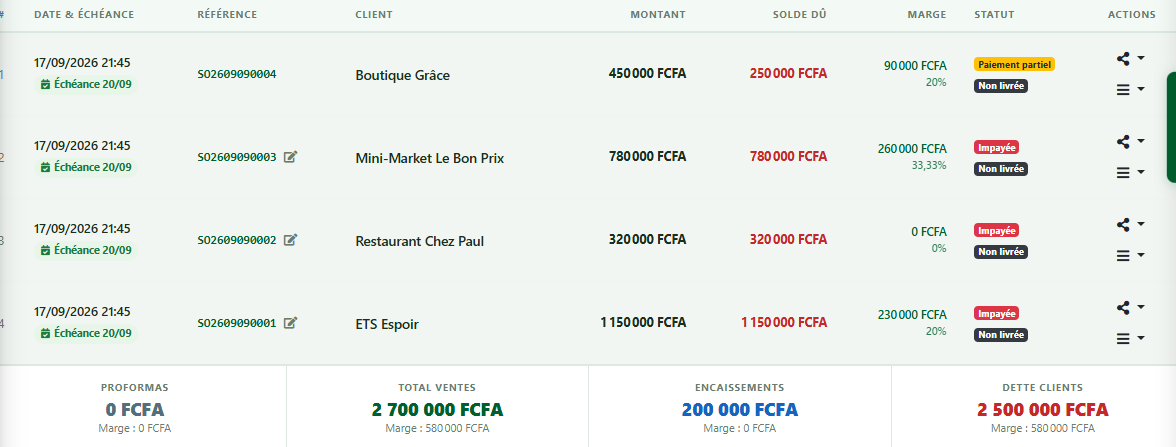
Kenfack Ibrahim has sold 2 700 000 F. But 2 500 000 F aren't in his till yet. This is where the case moves from a single invoice to a real SME management problem.
What Kenfack Ibrahim can now know
With zBilling.net, he finds in one place: the customers who still owe him money, the amounts still outstanding, the payments already received, the invoices involved, a customer's history, and the receivables starting to age. His dashboard shows the company's sales and debt levels directly, without having to open a single invoice.
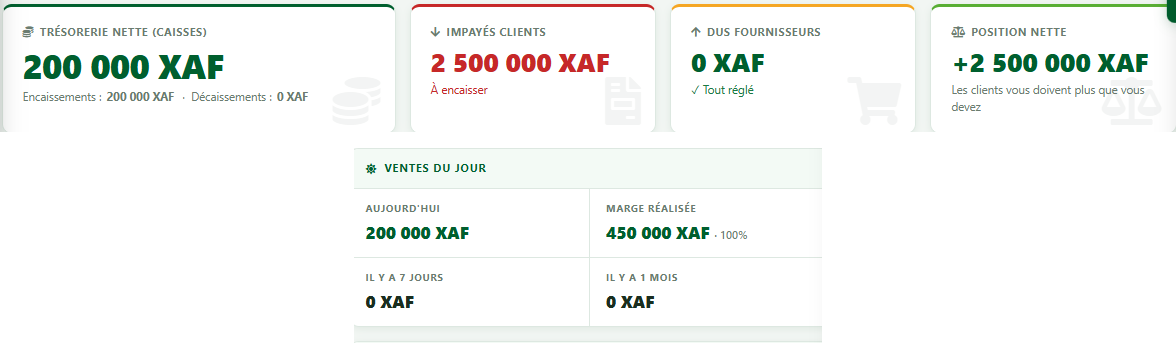
The goal isn't to memorize more information. The goal is to no longer have to memorize it.
What this changes for the business
- 1Organize follow-ups better.
- 2Avoid forgetting certain receivables.
- 3Cut down on arguments like "but I already paid."
- 4Quickly pull up a customer's history.
- 5Better understand why strong sales activity doesn't necessarily produce cash flow right away.
With zBilling.net, keep a clear record of your invoices, your payments, and what's still left to collect.
